
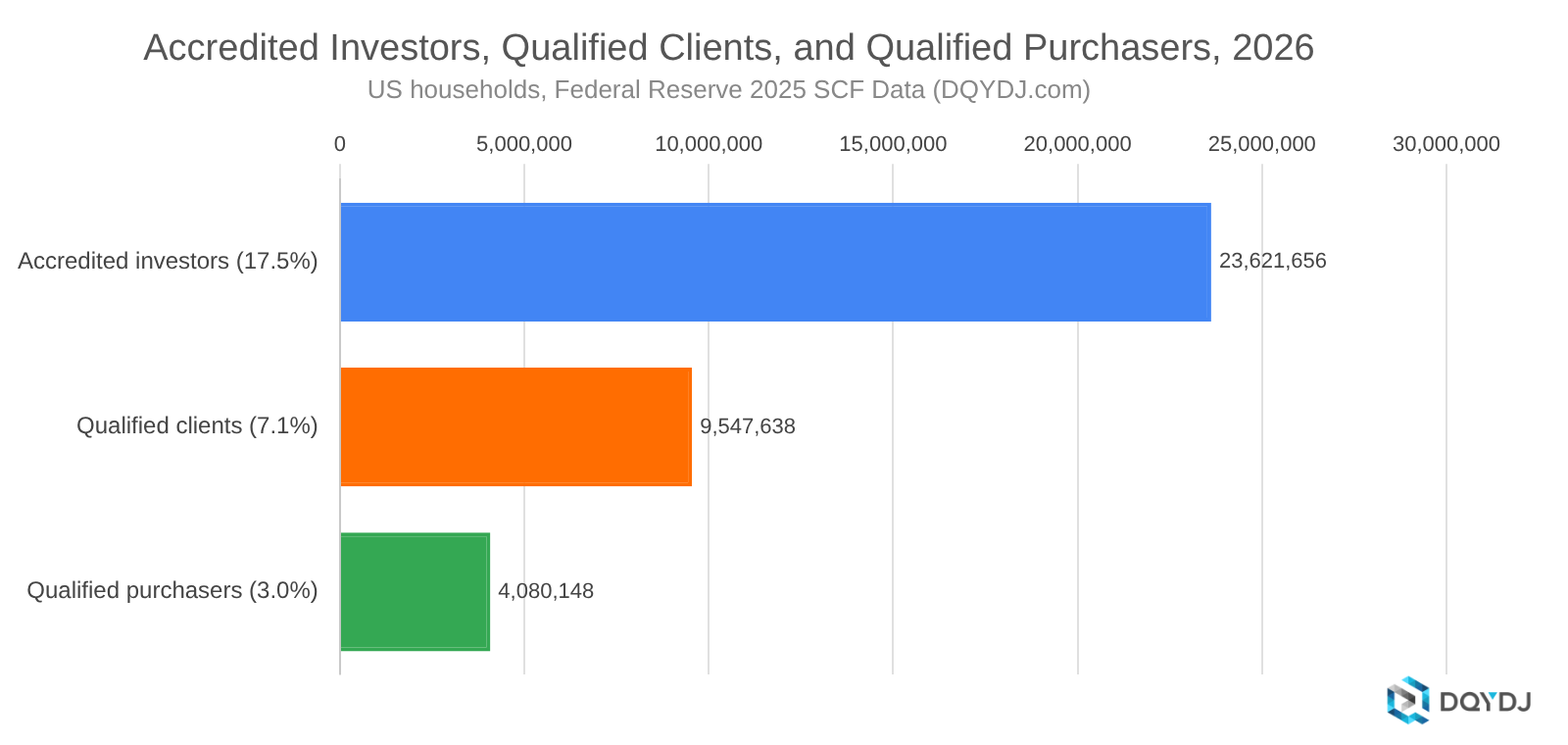
I estimate that 9,547,638 United States households, or 7.07% of all households, were qualified clients in 2026.1 About 2 in 5 (~40.4%) of all accredited investor households were also qualified client households.
Further, qualified client households controlled about $107.7 trillion in wealth. Per the 2025 SCF microdata, that translates to an estimated 64.8% of all private household wealth in the United States and 79.3% of accredited investor wealth.
Our estimates come from the 2025 Federal Reserve Survey of Consumer Finances, released in October 2026. Around one-seventh of interviews were conducted in early 2026. It's the newest data until roughly late 2029.
1 - Using a $2.7 million threshold in effect since June 29, 2026. At the older $2.2 million threshold, 11,753,241 households (8.71%) qualified.
What is a qualified client?
Qualified clients are a special class of investors defined under the Investment Advisers Act of 1940. The most common way to qualify is to exceed $2.7 million in net worth – not including equity in your primary residence.
Most importantly, qualified clients can be charged performance-based fees.
Qualified client criteria (and inflation adjustment)
Rule 205-3 under the Investment Advisers Act sets out the criteria to be a qualified client.
- You have a net worth (including held jointly with a spouse) exceeding $2,700,000*
- You cannot count equity in your primary home in your net worth calculation.
- (or) You will have at least $1,400,000* under management with the adviser right after you sign on
- (or) You are a qualified purchaser
- (or) You are an executive, partner, or similar of the adviser
- (or) You are an employee who takes part in the adviser's investment activities, and have for at least 12 months
I estimate qualified client households based on the net worth and assets under management tests (the other ways depend on an adviser). The net worth math is identical to my methodology for determining accredited investors – except dropping the income test and changing the thresholds. Note the rule counts net worth held jointly with a spouse, and the survey can't differentiate – again, these are household proxies.
For the assets under management test, I count households with $1.4 million or more that report a managed investment account. The survey records one value for trusts and managed accounts together, so households with both count in full. It adds around 7,000 households to the screen.
* The SEC adjusts these for PCE inflation about every five years. These thresholds took effect June 29, 2026 (91 FR 23520). The previous thresholds were $2.2 million and $1.1 million.
Performance fees
Performance fees come in various forms. Carry or carried interest is a common example of a performance fee in Venture Capital, Angel, Hedge Funds, and PE Funds – often known as promote in Real Estate Funds.
While fee structures differ, a widespread arrangement is known as "2-and-20". Here, a fund will charge a 2% annual fee on assets under management and a 20% carry or promote over a certain threshold, benchmark, or hurdle. For example, that performance fee may be charged as a percentage of the total return over the returns of an index, interest rate benchmark, or returns after all original capital is returned.
But to sum it up: private arrangements are incredibly varied, unique, and creative. While 2-and-20 is the most common arrangement, funds have all sorts of different hurdles, and some have multiple tiers of payouts (in real estate syndication, this is usually known as a waterfall). Enumerating all of the forms is beyond the scope of the article – all I can say is make sure you model out potential timing, returns, and scenarios and know what might happen before you invest.
Qualified clients and accredited investors
While being an accredited investor opens up many investment opportunities, you'll need to be a qualified client before you can join many funds. Since carried interest is common in various private investment funds, hitting the net worth threshold to be a qualified client is where a bigger universe of private investment options opens. Other funds push it a step further, requiring you to be a qualified purchaser, which frees them to raise investment money from more than 100 investors without triggering increased disclosure requirements.
I compare the three investor qualifications here.
And it gets more confusing! The gap between accredited investors and qualified clients may soon close. On October 6, 2026 – right before we went to press on this series! – the SEC proposed amending the qualified client definition to include anyone an adviser reasonably believes is an accredited investor.
Interested in net worth? See all our net worth or investing posts, or zoom into some of the most popular:
- Net Worth in the United States
- Net Worth by Age in the United States
- Net Worth Percentile Calculator (which lets you screen out primary home equity)
- Stock Return Calculator
- ETF Return Calculator
For past versions of this post, see here:
