DQYDJ

  • About Us
    • Contact Us
    • Resources
    • Disclosures
  • Tools & Research
    • Stocks and Investments
    • Personal Finance
    • Economics
  • Blog
    • Investing
    • Economics
    • Personal Finance
      • Debt
    • Politics
    • Real Estate
    • Offbeat
      • Weekender

Income Percentile Calculator for 2016 US Data

Economics     September 4, 2017 by PK 16 Comments

This article contains an income percentile calculator which will calculate 2016 income percentiles for the United States, based on all individual earners.  It originates from the March Current Population Survey, so data for comparison is all income you (or your friend) earned between January and December 2015.

We also have calculators which break income down by age: 2013 Income by Age • 2014 Income by Age • 2015 Income By Age.  (Net worth by age is from 2013 survey data, and found here.)

Notes: The tool has a logarithmic scale by default, but you can turn it off with the included checkbox.

Who Are the 1% in America in 2016?

The 1% has generally means the top 1% of income earners in the United States.  Our data allows us to provide one definition of the 1% based on individual earners.  The top 1% of those in (or close to) the workforce means:

  • There are roughly 1.65 million individual income earners in the 1%
  • Earning over $288,000 (including all forms of income – salary, business, interest, etc.) would put an individual in the 1% in 2016 in America

And how about the .1%?

Near the top of the income charts, public microdata from the CPS is screened and topcoded.  Our estimates near the top are a bit hazy.  Working with what we have (but please, allow some error), we can state:

  • Roughly 165,000 individuals make up the top .1% of income earners
  • Earning over ~$1,100,000 would put you in the top .1% in America in 2016

But again, this is a rough cut.  Earners at this level are even less likely to complete a survey, so there is a dearth of data at the highest end.

Note too that some definitions of the top 1% and .1% only count household income.  We’ll revisit with our household income article.

Source and Methodology on the Income Percentile Calculator for 2016

The University of Minnesota’s IPUMS-CPS project compiles all the data we use in this tool.  The CPS is a joint survey from the Bureau of Labor Statistics and the Census Bureau.  The data in the tool comes from the March  Annual Social and Economic Supplement (ASEC).  March is when many people are in the process of doing their taxes (or have recently finished), so the income estimates should be very good.

We use an expansive definition of what it means for people to have or want to have a job.  In response to comments and complaints about selection bias in previous calculators, we are now using people who report working at least one hour a week in the previous year, report they worked in the last year, or report that they currently want a job.  All of these groups make up the calculations in this tool, and the lowest percentiles are occupied by people who did no work in all of 2015.  A future 2016 calculator will screen this demographic out for full time workers, but this tool includes the widest possible definition of workforce on DQYDJ.

A note on accuracy: CPS data is self-reported and introduces some inaccuracy compared to IRS reported income numbers.  Additionally, before microdata is released to you and me it is topcoded.  Very high income earners are easier to personally identify, so their responses might be stripped from the survey.  This leaves a very slight downward bias to the data.

For our purposes, we can trust the results from the calculator.

What Do We See in This Year’s Individual Income  Data?

Our data is mostly comparable to last year, despite the minor methodology change explained above.

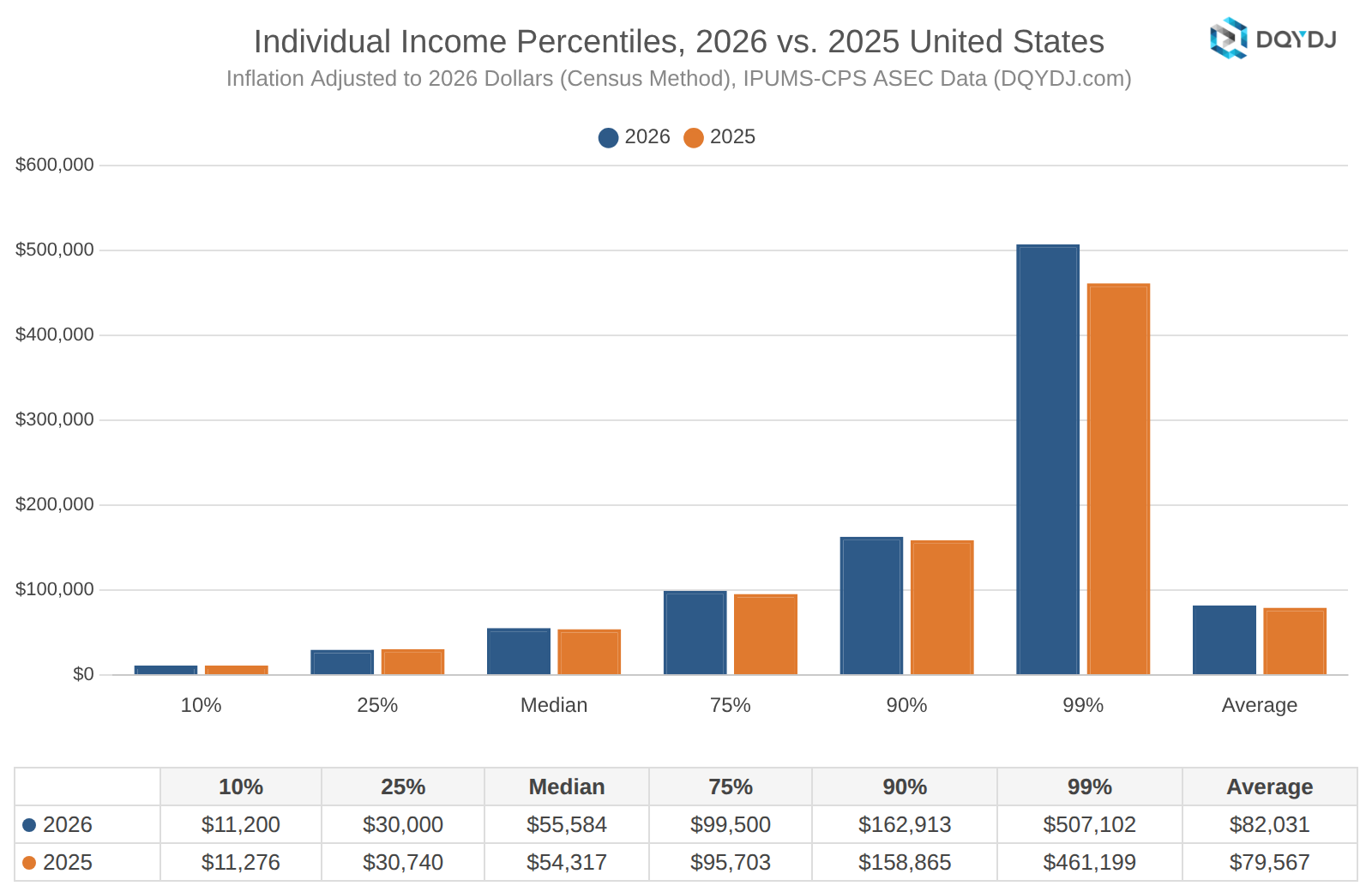
Here’s the improvement or decline at every income decile versus last year’s calculation:

Percentile20152016Improvement/Decline
10$10,000.00$9,516.00-4.84%
20$17,000.00$17,000.000.00%
30$23,438.00$24,000.002.40%
40$30,000.00$30,003.000.01%
50$36,628.00$37,848.003.33%
60$45,025.00$46,025.002.22%
70$56,000.00$58,000.003.57%
80$72,150.00$75,000.003.95%
90$101,680.00$104,982.003.25%

The median worker is seeing a nice gain this year – a full 3 and a third percent over the 2015 data, or another $1,220 a year.  That’s significant when spread over the economy, and it’s good to see some durable gains showing up in the economy.

Income percentile calculator: deciles of individual income in 2015 and 2016

Note the decline in income in the 1st decile might be the methodology change introducing additional people, or it might be more people entering the workforce.  It’s impossible to say without further digging.  Either way, that’s a pretty wide-ranging improvement, and not just for the top 10%.

Past editions: 2014 Calculator, 2015 Calculator

See anything else in the income percentile calculator… either in isolation or compared to past calculators?  Want to see us slice the numbers in a different way?  What to see household income instead? Let us know what you think in the comments!

Related Posts:

  1.   Female and Male Income Percentile Calculator by Age for the United States in 2016
  2.   Income Percentile Calculator for 2014 US Data
  3.   Income Percentile Calculator for 2015 US Data
  4.   2016 Household Income Percentile Calculator for the United States
  • Twitter Transparent PNG
  • Facebook Transparent PNG
  • LinkedIn Transparent PNG
  • Reddit Transparent PNG
  • twitter
  • facebook
  • linkedin
  • google+
  • reddit

Filed Under: Economics Tagged: 2016 individual income, asec, cps, income percentile, ipums

Comments

  1. Michael Rossman says

    Please include information on how many individuals are in the population being discussed.

    Reply
    • PK says

      It’s 92,381 data points. The weights add up to ~164,798,100 people out of a base of 185,487 data points representing a US population of 318,868,500 (some are removed due to topcoding, etc.).

      I’ll do a tutorial on exactly how I slice it because I want to help people play with this data as well. I have something built for 2015 I can adapt, but it’s a bit busy over here personally – look for something after I get all of the calculators out.

      Reply
  2. JMZ says

    Per your 1%er note, there would be 1.65 million individuals in that tranche, not 16.5 million; additionally, in the 0.1%er cut, there would be 165,000 individuals, not 1.65 million.

    Please absolutely feel free to delete this comment after reading.

    Reply
    • PK says

      Ha, good looking out! Thanks, fixed.

      Reply
      • Mike says

        “Roughly 165,000 million individuals make up the top .1% of income earners”

        So, 165 billion individuals?

        Reply
        • PK says

          Ha, thanks. My mind is elsewhere…

          Reply
  3. cmr says

    are you still excluding some individuals in your distributional analysis? such as people who don’t work and don’t report they would like to? I ask because some other sites take this same data yet use the entire population in the CPS and come up with different numbers than you. Are you excluding certain individuals in the data? TY.

    Reply
    • PK says

      There’s some nuance here, so yes and no – but I’ll state it carefully. Yes, we are excluding certain people from the data. No, we are not excluding people who don’t work but want to work.

      We put the full methodology in the parent calculator: https://dqydj.com/income-percentile-calculator/

      Essentially, the sample is: people who reported working at least one hour per week OR reported working in the last year OR (did not work AND wanted to work).

      Reply
  4. John says

    Is that pre-tax or post-tax total annual income? It makes a big difference!

    E.g., to take an even number, if your total annual income before taxes is $100,000/year, you fall in the 88.4% percentile.

    Let’s say taxes take out $33,000, leaving you with $67,000/year. That brings you down to the 76.2% percentile.

    Reply
    • PK says

      Pre-tax – tax is somewhat difficult to estimate with ACS/CPS microdata. There are some estimates on taxes (especially as relates to the poverty figures), but you mostly need to model them.

      Reply
  5. Philip Varghese says

    Is this based on individual income or both members in a dual income household. If in a dual income household, should one sum incomes and divide by two when using the calculator?

    Reply
    • PK says

      This is an individual income calculator, so you would only look at one income at a time. We do have a household calculator now, though: https://dqydj.com/household-income-percentile-calculator/

      Reply
  6. Steve Bursten says

    I see this is individual income. Do you have median HH income? I have read in Pam Danziger’s report that 20% of homeowners exceed $100,000 v. your approx 10%. Can you help me square this data?

    Reply
    • PK says

      Please find the most recent here: https://dqydj.com/household-income-percentile-calculator/

      Reply
  7. Rico says

    Why is it that other reputable sources quote the US median personal income as being slightly below $30,000, whereas the figure is almost $38,000 for you?

    Reply
    • PK says

      Likely a different methodology, especially for counting the workforce. If you try the HHI calculator figures should be closer (or exact, depending on source – public data has topcoding/some DPs removed): https://dqydj.com/household-income-percentile-calculator/

      Reply

Leave a Reply Cancel reply

Your email address will not be published. Required fields are marked *

Join Our Mailing List Today

ABOUT PK  962 Posts

I turn caffeine into useful tools and interesting posts. I also designed (and started) Don't Quit Your Day Job...

Contact PK
Follow PK on Twitter

TRENDING

  • +255%   Net Worth in the United States: Zooming in on the Top Centiles
  • +173%   What is the True Inflation Rate?
  • +145%   What Will Save You More Money At Work? Bringing Lunch or Buying It?
  • +143%   Don’t Use Leveraged ETFs (Unless…)
  • +129%   Daily Inflation Calculator – Since 1913!
  • +94%   Avoiding 401(k)s: Bypassing The Worst Financial Decision Possible

Featured Articles

  • Can You Grow Wealth with Stocks? The Story of Ronald Read.
  • Compound Interest Calculator (and the Compound Interest Formula)
  • Compound Annual Growth Rate Calculator (CAGR)
  • Bond Yield to Maturity Calculator
  • Treasury Return Calculator, With Coupon Reinvestment
  • Milton Friedman’s Permanent Income Hypothesis

POPULAR  IN THE LAST WEEK

  • Income Percentile Calculator for 2016 US Data
    6,667 Views Economics
  • Net Worth in the United States: Zooming in on the Top Centiles
    5,392 Views Economics
  • Net Worth by Age Calculator for the United States
    5,148 Views Economics
  • S&P 500 Return Calculator, with Dividend Reinvestment
    4,766 Views Investing
  • A Calculator: Income Distribution by Age for 2016 in the United States
    3,120 Views Economics

Recent Comments

  • Julius on 2016 Household Income Percentile Calculator for the United States
  • PK on How Many Software Engineers were there in Core Based Statistical Areas (CBSA) in 2016?
  • Steveark on How Many Software Engineers were there in Core Based Statistical Areas (CBSA) in 2016?
  • PK on A Calculator: Income Distribution by Age for 2016 in the United States
  • Nick on A Calculator: Income Distribution by Age for 2016 in the United States
  • PK on Stock Return Calculator with Dividend Reinvestment (DRIP) for EVERY Stock
  • jim on Stock Return Calculator with Dividend Reinvestment (DRIP) for EVERY Stock
  • PK on Stock Return Calculator with Dividend Reinvestment (DRIP) for EVERY Stock

About DQYDJ


We're a finance blog with a twist: we write articles, but we also create calculators and visualizations to help you understand your finances and take control of your investments.

[ Read More About Us ]

Quick Links

  • Contact Us
  • Advertise on DQYDJ
  • Disclosures
  • Recent Posts
                 

Search DQYDJ

DQYDJ Categories

© Copyright 2016 DQYDJ.com