
Hello from New Hampshire!
I know, I know. I keep saying this newsletter goes out "up to once a month," but the stats put me closer to once a quarter. But at least it's been long enough that I can complain about something other than the snow.
Either way, welcome back to the DQYDJ Weekender, and welcome aboard to all the new subscribers. And if you are new, sorry the first thing I do is say "sorry."
Plenty has been going on behind the scenes, though, as you know if you've been watching the feed. And a lot of it is in or around investing.
New on DQYDJ
S&P 500 fundamentals, liberated
For years we had a pile of S&P 500 fundamentals data feeding a few calculators. The evolution of search and AI on the internet (and your emails asking me where to find 'x') convinced me I need to work more on exposing what I've got.
On that theme, I've split out a bunch of the S&P 500 data into individual pages with a little help from my AI friends:
- S&P 500 Earnings Per Share (EPS) History
- S&P 500 Dividend Per Share History
- S&P 500 Payout Ratio History
- S&P 500 Sales Per Share History
- S&P 500 Earnings Growth
- S&P 500 Dividend Growth
- S&P 500 Sales Growth
All of these new tools flip between nominal and inflation-adjusted – as you'd expect from a DQYDJ tool – and let you play with the timeframes.
A few of the old valuation pages were reworked while I was in there – notably, the PE Ratio, P/S Ratio, Profit Margin, and the Buffett Indicator.
Drawdowns and annual return rankings
Based on another popular theme from some of the individual stock and cryptocurrency calculators, I built out some new "how bad did it get, and how did each year stack up" tools for indices:
- S&P 500: Drawdown History and Annual Return Rankings
- Dow Jones: Drawdown History and Annual Return Rankings
- NASDAQ: Drawdown History and Annual Return Rankings
Rates and cross-asset comparisons
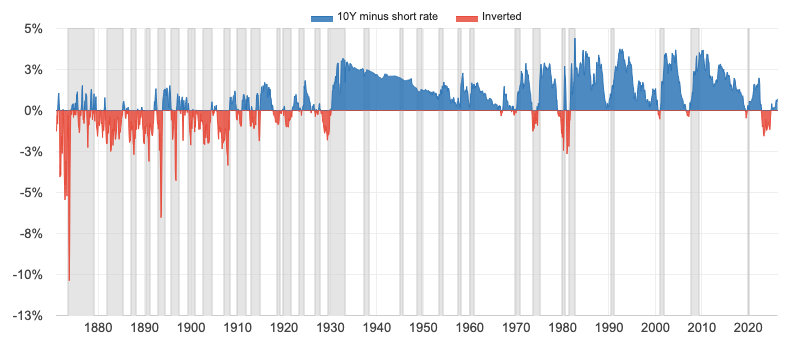
Reminisce with me for a second: eight years ago, I wrote a well-reviewed post on the long-run yield curve, torturing a few series to graph a good proxy for short-term yields. At the time, I put a lot into the visualization, but I've always wanted to make it interactive... and it's a lot simpler to do that now than in 2018, so I did!
Here are a couple tools that came out of that effort:
- US Long-Run Yield Curve: 10-Year vs. Short Rate Since 1871
- Stocks vs. Bonds Historical Returns Calculator
I'm short on inversion jokes. But stick around, it'll pay off in the long run.
Investing is now easier to navigate
Last edition, I mentioned paying off deferred maintenance on the site (not my house, I left that joke for you to make).
I finally added subcategories to the Investing category, which should make it easier to navigate. You can still see the whole mess on the parent category page, but you'll be greeted by 7 new subcategories which include all the classics plus the new posts and tools.
Take a look at the whole thing: dqydj.com/investing/ and try out the subcategories that resonate with you.
AI and increasing returns to curiosity
You may have heard of the "10x engineer." One version of the AI story is that soon everyone is a 10x everything. But I don't buy that.
AI, in its current form, is a multiplier on what people already bring. And the broader question that interests me isn't whether AI replaces people. It's who it multiplies – and by how much.
Back in September I coined a struggle threshold: if you could have tackled a project given enough time, research, and determination pre-AI, AI makes it much more doable. I compared the concept to an old TV-antenna amplifier – it can't create signal where there's none, but it makes a weak signal stronger. That is, AI seems to amplify the capability you already have; it doesn't replace the need to understand what you're building.
There's real evidence for a signal floor: hand AI to people already in a field and it pulls them toward the frontier. Brynjolfsson, Li, & Raymond watched 5,000+ support agents using AI – output was up 14%, including a whopping 34% for the greenest of them. Noy & Zhang recruited professionals to complete writing tasks with AI – time taken decreased, output quality rose, and inequality between workers decreased. Cui and company gave 4,867 developers an AI assistant and saw 26% more tasks shipped, with juniors pulling ahead fastest. Same song every time: the gap between the best and the rest compresses.
It's important to note: those three studies clocked people on bounded work with externally assigned goals and measurable outputs. Recently, Anthropic looked at self-directed work – ~400,000 Claude Code sessions where users decided what to work on and steered the agent themselves – in a paper titled "Agentic coding and persistent returns to expertise." Their finding: domain expertise, not coding skill, is what drives results. Experts get the agent to do ~12 things per instruction; novices, about 5. On the cleanest measure – verified success – experts roughly double novices (33% vs. 15%). And when a session goes sideways, experts pull out at least a partial win far more often (80% vs. 60%) and abandon ship far less (7% vs. 19%).
Their paper is careful about its limits – and they try to net out the obvious confounder (by comparing sessions doing the same kind of work, at the same estimated value, in the same month) – though it stays a little squishy when Claude is the one inferring expertise. Still, "persistent returns to expertise" in the title aside, a couple of lines I keep coming back to: "the gap between experts and intermediates is modest—suggesting that proficiency in a domain is enough to use the tool almost as effectively as those with deep mastery." and "a working grasp of the domain captures most of the benefit, while deep specialization adds only a bit more beyond that." More on those in a second.
Isn't that curious?
The first three studies read like pure leveling – but everyone in those studies already had the job. A struggling consultant is still a consultant; a green rep was still hired and trained for the role. And combine the results from those three studies with the quotes I pulled from Anthropic's paper that suggest AI gains aren't reserved for masters, even if their work found them gaining the most.
So here's a hot take: curiosity can get you in the door. It can propel you into a field that was never your job, and let you bootstrap from scratch to the working grasp these studies show AI rewards. If you've done the foundational work and poked at enough corners of a field you might even start to develop taste: a feel for which corners matter.
That's why I want to coin my own riff on Anthropic's research title (and off the increasing returns to scale we've heard about for years): we may be seeing increasing returns to curiosity.
If you listen between the lines, you might be able to hear it in Anthropic's experience. Recently on Odd Lots, Anthropic's Head of Economics, Peter McCrory, described directing Claude "the same way that you might redirect a grad student" and discussed the need for "research taste." Co-founder Jack Clark described a "barbell" in Anthropic's hiring – more senior people than before since "their intuitions and their ideas for what to pursue are massively compounded by AI systems" along with "AI-native" junior hires. "[S]enior people" aside, taste and ideas aren't necessarily reserved for the experts.
So that's my take. And here's the wager: the people who pull ahead won't be the ones with the biggest head start – they'll be the ones curious enough to want to understand a corner of the world, motivated enough to do the foundational work, tasteful enough to know what to pursue, and willing enough to use the AI multiplier to do the rest. (Curious generalists take note.)
Will the lane last? Fair question – the frontier keeps moving and everyone has the same tools (for now). But I'm not betting it vanishes. When the bar rises, AI might just get you to it faster: knock Gladwell's 10,000 hours down to whatever number you believe. I'd guess the durable skill is staying curious about where curiosity pays, and doing the reps once you've picked a spot.
And the other obvious caveat: you can only lift what's already there; lean on AI without curiosity and you may never take off.
Anyway... tell me where I'm wrong. I'm curious.
Home updates
This section plays well for you all (but especially my coworkers on Slack):
The deck railing project is finally, actually done. I'll show you the last rail:

It's the only rail that survived the winter to-do list, because I had to route a pocket out of the bottom to clear the bracket, and I really didn't want composite shavings all over the garage. Isn't it beautiful? And check out that 60 degree angle!
Now I'm back down in the basement, revamping what was there and cleaning up after the one-two punch of rodent damage (don't worry, I tossed that insulation long ago) and some leaks that forced drywall redos.
Next up: getting a floor back in down there. I'll tell the tales of the basement repairs next time, depending on progress. And with the girls? A lot of summer sports.
What's cooking
First up: happy trails to the incredible Howard Silverblatt at S&P Dow Jones Indices, who retired after almost five decades of service. I historically leaned on his work for a lot of my S&P data, and he's been a quiet institution for anyone who cared about the index fundamentals. Enjoy your retirement, Howard!
Next on the DQYDJ roadmap: I've got a couple requests so I'm hunting down clean historical book value and buyback data for the S&P 500 to round out the fundamentals set. Wish me luck.
And the usual reminder, because I am often asked: new income and net worth data should land in late fall, with the next Survey of Consumer Finances cycle and annual public ASEC release cycle.
Other than that, what else do you want to see? Seriously, reply and tell me what's missing. A large number of posts, visualizations, and tools exist on DQYDJ because someone hit reply on one of these emails, or mailed me from the contact page. Or, yes, complained about something stale in the archives. C'est la vie.
Thanks for reading! See you next time... optimistically, let's call it "soon."
